We have already told you why Enkopiro is wild. Why we chose to remain small by design. Now it is time to explain the third part of our philosophy: deep impact.
When people talk about responsible travel, the conversation often begins with what we should avoid.
Use less water.
Produce less waste.
Reduce emissions.
Protect wildlife.
All of these things matter. But we believe the conversation should go further, because perhaps the real question is not only:
How can tourism do less harm?
Perhaps it is:
How can tourism leave something better behind?
That is where our idea of Deep Impact begins.
Tourism is never neutral
Every safari has an impact.
A vehicle drives across the landscape. A tent uses water and energy. Food has to arrive. People are employed. Land has an economic value. Communities make decisions about how they use their resources.
There is no such thing as a safari that leaves no footprint. The question is what that footprint contributes to.
At Enkopiro, we believe tourism can be more than an economic activity taking place in a beautiful landscape. It can become part of the reason that landscape remains protected.
Part of the reason people can build livelihoods without leaving their community.
Part of the reason children can access better education.
Part of the reason healthcare can exist closer to home.
Part of the reason wildlife and people can continue sharing the same land.
That is what we mean by Deep Impact.
From sustainable to regenerative
We deliberately use the word regenerative. Not because it is a fashionable new term, but because it describes something we believe is fundamentally different.
Sustainability asks us to maintain. Regeneration asks us to improve.
To leave a place not simply as we found it, but with stronger foundations for the future. For us, this does not mean pretending that tourism can solve every challenge facing the Maasai Mara. It means recognising that tourism has a responsibility to contribute to the long-term wellbeing of the place that makes the experience possible. And that contribution has to be real.
The landscape is part of the experience
Guests come to the Maasai Mara for wildlife.
The lions.
The elephants.
The giraffes moving through the grasslands.
The enormous skies.
The light at the end of the day.
But none of this exists independently. Wildlife needs land. Land needs people who have reasons to protect it. And conservation needs a model that can work economically over the long term. In community conservancies, these connections become very visible.
Land is not simply empty space between wildlife sightings. It belongs to families and communities. The decisions made about that land influence whether wildlife corridors remain open, whether habitats are protected and whether the wider Mara ecosystem can continue to function.
Tourism can give conservation a tangible value. And when that value reaches the people who live here, conservation becomes something that belongs to the community too.
The people behind your safari
There is another part of the story that is easy to overlook.
- The person who welcomes you to camp.
- The chef preparing your dinner.
- The guide who knows which track belongs to which animal.
- The spotter scanning the horizon.
- The person maintaining the camp.
- The local craftspeople.
- The people who provide services and supplies.
A safari is made possible by many people. At Enkopiro, we want the value created by tourism to reach beyond the guest experience. Employment matters. Skills matter. Training matters. Motivation matters. But so does creating opportunities for people to build something that lasts beyond a single season.
That is why, for us, community is not an activity we add to a safari itinerary. It is part of the foundation of the safari itself.
When a camp becomes part of its community
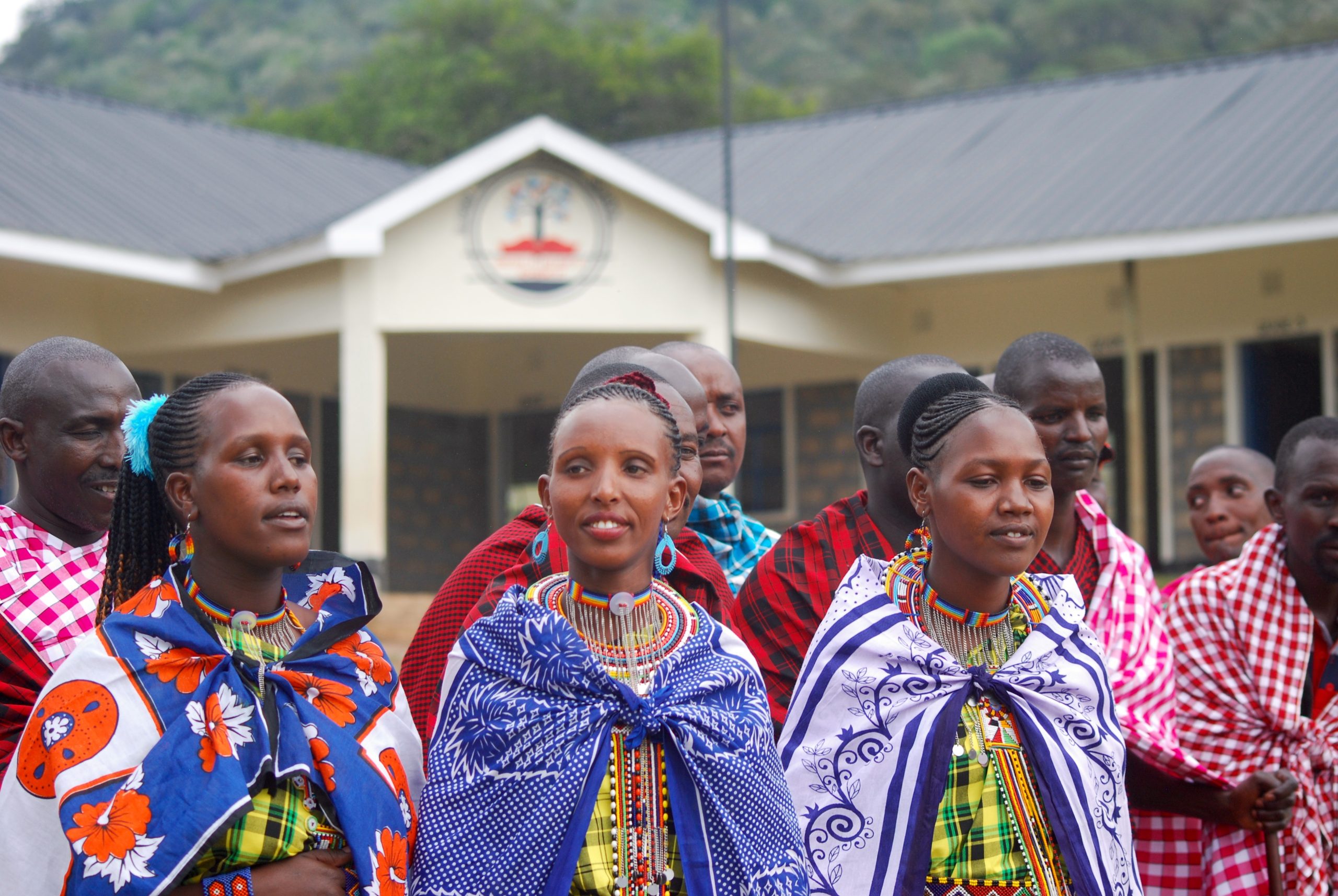
Over time, being part of Ololasurai has meant becoming involved in things that happen far beyond our four tents.
Education is one of them.
At Olchoro Lemayian Primary School, what began as support for a local school has grown into a much broader commitment to education in the valley. There are classrooms to build, children to feed, teachers to support and, increasingly, opportunities for students to continue their education beyond primary school. Because what started with 5 classrooms, 58 kids and 5 teachers it has become a project with 8 Classroms, 1 ICT Room, 139 kids (50 in boarding), 11 teachers and one cook.
The goal is not simply to build another classroom. It is to create possibilities and future. Because the impact of education is rarely visible immediately.
It appears years later, when a child who once walked to school becomes a teacher, a nurse, a guide, a pilot, an entrepreneur, a conservationist — or simply a parent who believes their own children deserve opportunities they did not have. Because conservation awareness is also teach at the school.
That is regeneration. This is our Generation Restoration. Not an immediate result.A stronger future.


Health is part of the same picture
The same principle applies to healthcare.
In 2026, the Naretoi Dispensary opened in our community, bringing basic healthcare closer to the people who live here.
For families, distance can be a barrier to treatment. A local dispensary can change that. But again, the impact is not only the building. It is the consultation. The medicine that is now accesible. The mother who can seek care closer to home. The child who receives treatment. The older person who does not have to travel as far. The delivery that is being assisted.
These may seem like small things. Together, they are not.


Conservation is not somewhere else
It is easy to think of conservation as something that happens inside a protected area, somewhere beyond the gates.
But in the Maasai Mara, conservation is also about the land surrounding those protected areas. Community conservancies create space for wildlife to move, habitats to remain connected and communities to participate in protecting the ecosystem.
At Ololasurai, we are part of that story. Supporting conservation does not mean simply putting a percentage of our revenue into a project and calling it impact. It means being present. Understanding the landscape. Working with local people. Supporting the protection of land.
And recognising that the future of wildlife is inseparable from the future of the people who share this ecosystem.
.  .

 .


The impact you don’t see
Perhaps the deepest impact of a safari is not something a guest will ever photograph.
It may be a piece of land that remains protected. A young person who finds an opportunity close to home. A child who stays in school. A mother who can access healthcare. A local guide who can build a career around his knowledge of the landscape. A community that sees wildlife not only as something beautiful, but as something worth protecting. These things rarely appear in a safari itinerary.
But they are part of the story.
A different definition of luxury
This is also why our idea of new luxury goes beyond beautiful tents, good food and exceptional service.
Luxury can be having space.
Having time.
Having silence.
Having a guide who can stop the vehicle because something interesting is happening rather than because it is on a checklist.
But perhaps there is another kind of luxury too.
Knowing that the experience you are enjoying is connected to something larger than yourself.
That your stay is part of a living relationship between tourism, people, wildlife and landscape.
That the place you came to experience has a future beyond your departure.
That is meaningful luxury to us.
Deep impact is a long-term commitment
We don’t believe one camp can change an entire destination. Nor do we believe regeneration happens overnight.
It is built slowly. Through relationships. Through consistency. Through decisions that may not always be the easiest or most profitable in the short term.
And through the understanding that hospitality is not simply about what happens to a guest during the few days they are with us. It is also about what happens here when they leave. Because a safari should create memories for the traveller. But it should also create value for the place.
So, what does Deep Impact mean?
For us, it means looking beyond the tent.
Beyond the game drive.
Beyond the immediate guest experience.
It means asking, again and again:
What can tourism give back?
Not as a marketing promise. Not as a percentage on a brochure. But as a long-term relationship with the land and the people who call it home.
We have chosen to be Wild.
We have chosen to be Small by design.
And because of that, we have the opportunity to be something else too: Deep in our impact.
Because perhaps the most meaningful thing a safari can leave behind is not something you take home with you.
It is knowing that, for a little while, your journey helped make it possible for this place to remain here — and become stronger for the people and wildlife who will still call it home long after you have left.
Enkopiro Camp
Wild. Small by design. Deep impact.